
What Executives Should Look for in a Public Speaking Coach
Jul 14, 2026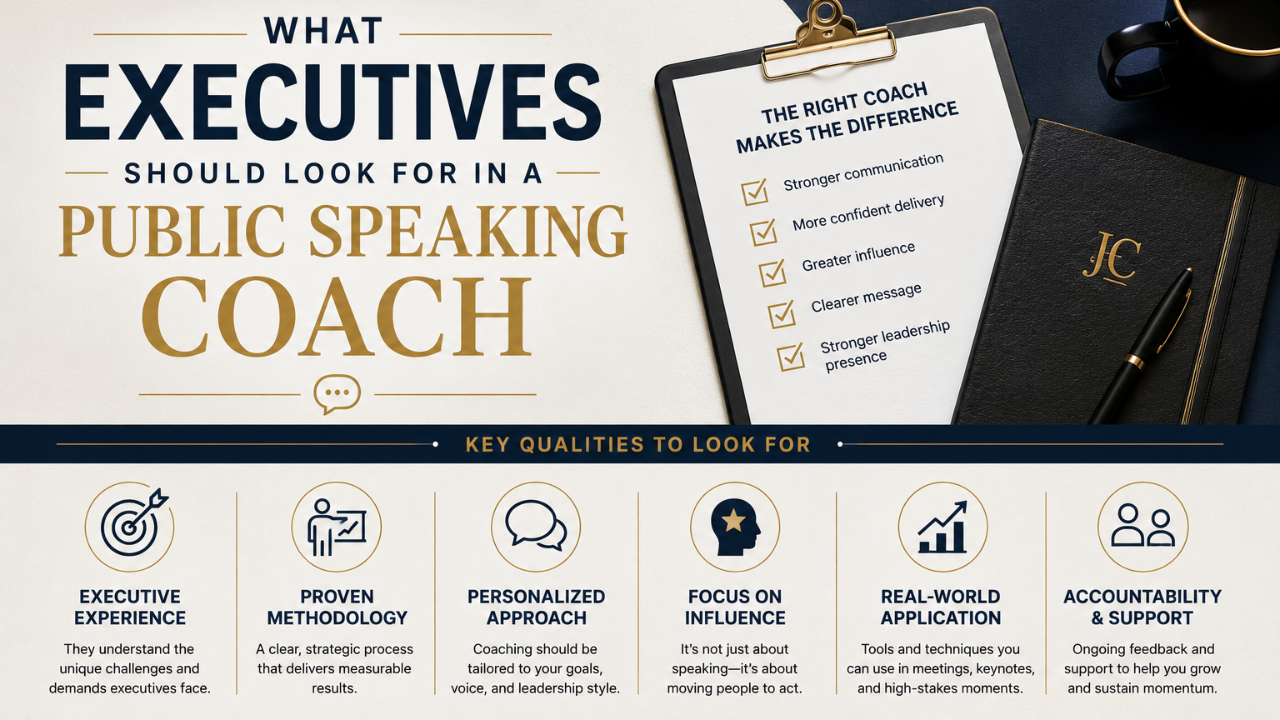
I get asked some version of this question constantly: how do you actually find someone who can prepare an executive for the moments that matter, not just deliver a decent keynote? My answer hasn't changed in years.
Find someone who has lived through what they're coaching you for. That's the entire premise behind Speakeasy, my practice in Bend, Oregon.
Most executives can deliver a rehearsed speech without breaking a sweat. The real test comes ninety seconds later, when a reporter asks something unscripted, or when the room goes quiet after a hard question in a boardroom.
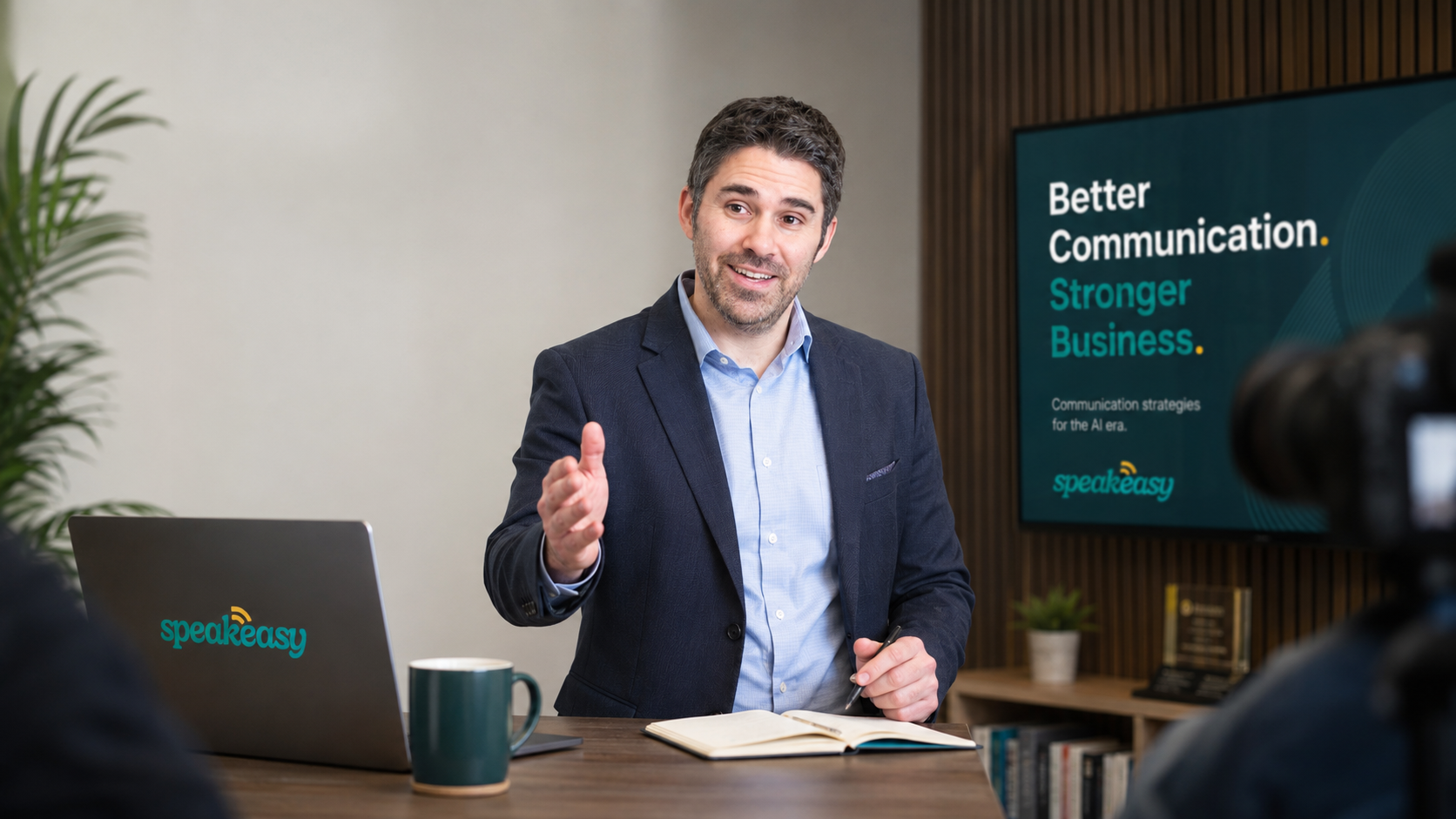
That gap, between performing well on a script and holding up when the script disappears, is what separates professional public speaking coaches for executives from a general presentation instructor.
Plenty of coaches can help someone deliver a polished talk. Far fewer can teach a leader to stay sharp and composed when the conversation goes somewhere nobody planned for. That's the bar I hold myself to, and once you see the difference, it changes how you evaluate a coach in the first place.
Key Takeaways
- The right coach for executives prepares you for consequence, not just delivery, since a single answer under pressure can shape a headline or move a stock price.
- Four qualities separate strong executive coaches from the rest: broad experience across formats, a personalized assessment instead of a fixed curriculum, recorded practice with visible feedback, and airtight confidentiality.
- One-on-one coaching consistently outperforms group training for executives, because every session can be built around your specific upcoming moment.
- My approach draws on years as a live television news anchor, which is why public speaking, media training, and PR preparation live under one roof at Speakeasy, right here in Bend, Oregon.
The Real Difference Between Executive Coaching and Standard Training
General public speaking training covers the fundamentals: posture, pacing, structuring a talk. Executive coaching starts from a different assumption entirely, that you already have the basics, and moves straight into the situations where a single sentence can move a stock price, unsettle a workforce, or land you in a headline you never wanted.
A study from the Institute for Public Relations surveyed more than 1,000 U.S. employees and found that CEOs who led with transparency, authenticity, empathy, and optimism during organizational change built significantly more trust with their teams, along with lower workforce anxiety. That's the standard I coach every executive toward.
A coach who has actually lived through unscripted, high-stakes communication brings something a theory-only coach can't. I spent years as a live television news anchor before I ever started coaching, so my whole approach centers on one thing: staying composed and on-message the moment a conversation goes off script, which is exactly where most executives need the most work.
The Communication Skills Executives Need Most Right Now
Delivery isn't the hard part anymore. Judgment under pressure is. Executive communication now stretches across formats that barely existed a decade ago, live-streamed town halls, podcast interviews, unscripted LinkedIn videos, and every one of them removes the prep time a formal keynote gives you.
Presence and Confidence
Content matters, but pace and poise do just as much of the work in shaping how an audience reads a leader's credibility. Research on first impressions shows people form judgments about competence and trustworthiness within seconds of hearing someone speak.
Storytelling That Sticks
Facts inform an audience. Structure is what makes an idea survive being repeated by someone else. Executives who tell a story well compress something complicated into a form a board member or reporter can recall accurately later. Getting there takes a coach who actually understands both the subject matter and what's on the line.
When It Actually Makes Sense to Hire a Coach
The best results come from preparing a leader ahead of a high-stakes moment, not cleaning up after an avoidable mistake.
A few situations make the timing obvious:
- A keynote address or conference presentation where you're publicly representing the company's philosophy
- A board or investor presentation where technical depth needs to land in language that's confident and concise
- A leadership transition, where a new executive hasn't yet built the communication skills the role now demands
- A period of organizational change, where the message has to be transparent and reassuring at once
- A media interview, where there's no option to pause, backtrack, or start over
How to Evaluate a Coach for Executives
Judge a coach on the range of real situations they've worked through with clients, not on how many years they've been doing it.
Four things matter most.
Range of Experience With Senior Leaders
A coach who has only ever trained executives for keynotes may not be much help when media prep is what you need. Someone who has actually handled high-pressure communication gives a fundamentally different kind of feedback than someone teaching from theory.
The strongest coaches for executives have sat through more than one kind of pressure themselves. If you're investing the time, that coaching should prepare you for more than a single scenario.
Personalized, Not a Fixed Curriculum
Executive communication styles vary enormously, so look for a coach who starts with an honest read on how you communicate right now, not a program built the same way for everyone.
Some leaders need help slowing down because they're naturally passionate and fast. Others are sharp and analytical but come across flat or distant. A coach locked into one rigid framework tends to miss those distinctions entirely.
Recorded Practice, Not Just Verbal Notes
Watching yourself hesitate, hedge, or lose eye contact is uncomfortable, and verbal feedback alone never fully captures it. Recorded practice is one of the only tools that gives you an honest before-and-after.
Confidentiality, Non-Negotiable
Executives regularly rehearse material touching on acquisitions, unreleased earnings, and other sensitive information. Any coach working with that has to treat discretion as the baseline, not a bonus.
Does One-on-One Coaching Beat Group Training?
One-on-one sessions let me build everything around what's actually coming up for you, an investor call, a reporter's likely line of questioning, whatever it is. The feedback loop is immediate too, instead of split across a room full of people chasing different goals.
Group workshops still have a place. They work well for low-pressure practice and exposing people to shared frameworks. What they can't do is adapt to the specific pressure points of your role, or the exact presentation you're giving next month.
Virtual Coaching vs. In-Person: Which One Actually Works?
Both formats work well when they're done right, the real question is matching the format to the goal.
Virtual coaching has become the default, and for good reason. It fits ongoing work, media prep, refining one presentation over several rounds, and it works around a packed schedule. Sessions get recorded and reviewed later, which is its own advantage.
In-person coaching still earns its place for large-stage rehearsal, where spatial awareness and audience energy actually matter. No amount of video quality replicates everything a stage does. I coach clients both virtually and in person out of Bend, and I also work with leaders across Redmond, Central Oregon, and the wider Pacific Northwest who fly or drive in specifically for in-person sessions.
Questions Worth Asking Before You Commit
Before signing on with a coach, ask things like:
Does the coaching start with an honest assessment of my current communication style, or is it a fixed curriculum?
Can this coach point to real experience with unscripted, high-pressure situations, crisis communication, live media, and the like?
Is the coaching limited to one format, like keynotes, or does it also cover interviews, panels, and unscripted Q&A?
What do the actual practice sessions and engagement structure look like?
Has this coach worked with leaders or organizations facing something close to what I'm dealing with?
Watch for anyone who can't answer "how will I know this is working" with something concrete. A vague reassurance instead of a real plan is a red flag worth taking seriously.
How Speakeasy Approaches Executive Communication
Most executives don't need more presentation polish. They need someone who has actually stood in front of a camera or an audience when the pressure was real, not theoretical. I spent years as a live television news anchor before I ever coached anyone, and that's exactly where this approach comes from.
Public speaking, media training, and PR preparation all live under one practice here, because in the real world, executives rarely need just one of those skills in isolation. A leader prepping for a keynote also needs to be ready for the media questions that follow it. A spokesperson handling a crisis needs message discipline and stage presence at the same moment.
That combination, broadcast experience, personalized coaching, and cross-format preparation, is what sets this apart for leaders who want one communications partner instead of a rotating cast of specialists. I work with executives and organizations throughout Bend, Redmond, and the rest of Central Oregon, plus clients across Oregon and the Pacific Northwest who train virtually.
Frequently Asked Questions About Professional Public Speaking Coaches for Executives
What does an executive public speaking coach actually do?
It starts with an audit of how you currently communicate. From there, sessions typically include live-pressure simulations, mock press conferences, hostile Q&A rounds, recorded practice reviewed frame by frame, and message calibration for different audiences, since a board update and a media interview call for different registers even when the underlying facts are identical.
Is this kind of coaching actually worth it?
Yes, when it's built around clear goals and measurable outcomes. A good coach can point to what actually changes: fewer filler words and hedges under pressure, cleaner answers that survive being clipped into a soundbite, faster recovery when a question goes sideways. Given how quickly first impressions form, those small, specific shifts matter more than they sound like they should.
Can this kind of coaching help with media interviews specifically?
Yes. Media-specific preparation covers how quotes get pulled and used, how to answer fully without handing a reporter a clip that gets used out of context, and how to redirect toward your intended message without sounding evasive.
How many sessions does an executive typically need?
Depends entirely on the goal. Preparing for one high-stakes event, an earnings call, a conference panel, takes a focused set of sessions built entirely around that moment. Building durable executive presence across formats is a longer engagement, usually measured in months, since the goal is communication habits that hold up under real pressure.
How is this different from general presentation skills training?
Presentation skills training sharpens a single deliverable with a fixed structure. Executive coaching prepares you across formats, and for the moments inside those formats that can't be scripted at all, an unexpected follow-up question, a technical detail you need to simplify on the spot.
How is this kind of coaching changing as communication formats keep shifting?
Leaders now communicate through virtual town halls, podcasts, webinars, media interviews, LinkedIn video, and hybrid meetings, sometimes all in the same week. Each format has its own pacing and its own risks, and none of them offer the editing room a written statement does. Coaching has had to move away from single-format training and toward preparing executives to shift registers quickly across all of them.
Final Words
Credentials matter, but they matter most paired with a coach who has actually operated under the kind of pressure they're now coaching you to handle. That's the standard behind every engagement at Speakeasy.
People don't remember executives for a perfect slide deck. They remember them for how they handled the moment nobody scripted. If you want to talk through what this could look like for your specific situation, booking a discovery call is the fastest way to find out.