
Corporate Public Speaking Training: What to Look for Before You Hire a Coach for Your Team
Aug 25, 2026
The best public speaking coaches for corporate training bring real performance experience, start with a discovery process, and build every session around the moments your team actually faces. Generic workshops teach generic skills. Corporate public speaking training works when it fits your people, your industry, and your calendar.
I spent nearly two decades delivering live television, and today I help organizations shape how their people speak, present, and show up on camera. Here’s what I’d look for if I were the one hiring a coach for my team.
Strong Corporate Public Speaking Training Starts With Your Team’s Real Moments
Before you compare providers, list the speaking moments on your team’s calendar. Client pitches, quarterly reviews, all-hands meetings, conference talks, and video calls with leadership all count.
That list becomes your evaluation tool. A coach who specializes in corporate training builds the agenda from it, not from a template.
Different teams need different things. Sales teams need tighter pitches, technical teams need to translate expertise into plain language, and leaders need presence that builds confidence across the organization. As I tell engineers: your work speaks for itself, but you still have to speak for it.
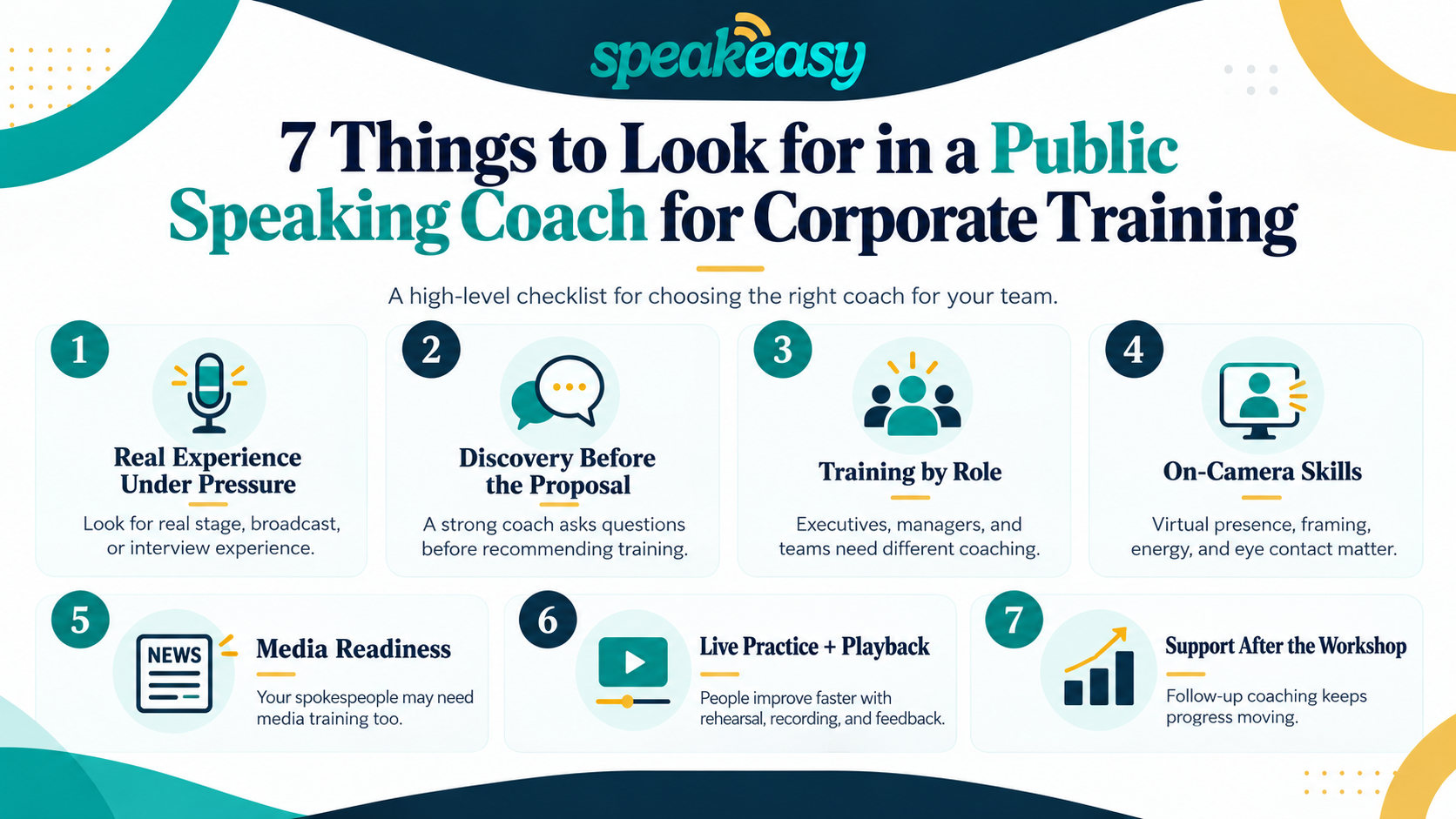
7 Things to Look for in a Public Speaking Coach for Corporate Training
1. Real Experience Performing Under Pressure
Look for a coach who has done the work in high-stakes settings, not just studied it. Live broadcast, keynote stages, and press interviews teach lessons a textbook can’t.
Ask how that experience connects to your team’s goals. Credentials matter most when they turn into skills your people can use on Monday.
2. A Discovery Process Before the Proposal
The right coach asks questions before recommending anything. Who presents, to whom, how often, and where do things stall?
In my own process, I ask how a team tells its story today, then rank its needs as high, medium, or low. That ranking keeps your budget focused on the skills that matter first.
3. Training Built Around Different Roles
One agenda rarely fits a whole company. A specialist adjusts the training for executives, technical staff, client-facing teams, and new managers.
Ask for examples of how the coach has customized corporate communication training for teams like yours.
4. On-Camera Skills, Not Just Stage Skills
Your team presents on video calls every week. Strong training covers framing, lighting, eye contact with the lens, and energy that carries through a screen.
This is where broadcast experience earns its keep. Years in front of a studio camera taught me what reads on screen, and those habits transfer directly to a virtual board meeting. It’s the same eye I bring to every Speakeasy video production project.
5. Media Readiness for Your Spokespeople
If anyone on your team talks to reporters, podcast hosts, or community audiences, look for a coach who also offers media training. One partner keeps your message consistent from the conference stage to the evening news. If you’re unsure which your team needs first, start with my breakdown of media training vs. presentation skills training.
6. Live Practice With Video Playback
People improve fastest when they see themselves. Look for sessions where participants present, watch the recording, and try again with specific feedback.
Practice-heavy presentation skills training for teams builds habits that last well beyond the workshop.
7. A Plan for After the Workshop
Skills grow with repetition. Ask what support continues after training day, such as follow-up coaching, refresher sessions, or one-on-one time for key presenters.
What Questions Should I Ask a Corporate Training Provider?
Use these questions on your first call. Strong answers will sound specific to your team.
- What does your discovery process look like before you build an agenda?
- How will you customize the training for our industry and roles?
- How much of each session is hands-on practice versus instruction?
- Do you cover on-camera and virtual presenting?
- Can you prepare our spokespeople for media interviews too?
- What support do participants get after the training?
- How will we measure progress?
Workshop, Small Group, or One-on-One: Which Format Fits Your Team?
Workshops build a shared language across a large group. They work well for company-wide standards and new-manager programs.
Small groups give each participant more practice time. They fit teams preparing for the same kind of presentation, such as a sales pitch or a quarterly review.
One-on-one coaching delivers the fastest growth for high-visibility people. Most organizations combine formats: a workshop for the team, plus individual coaching for leaders and spokespeople.
How to Build the Business Case for Corporate Public Speaking Training
If you’re the one taking this request upstairs, frame it around outcomes. Clearer presentations shorten meetings, sharper pitches win more business, and media-ready leaders strengthen the brand.
The research supports the investment. In NACE’s Job Outlook 2026 research, employers ranked communication among the most important career skills, yet gave new graduates lower marks for communication than for teamwork. That gap shows up in organizations of every size, and focused training closes it.
Set two or three measurable goals before training starts. Examples include stronger client feedback after pitches, higher presenter confidence ratings, or more team members ready to present to leadership.
How Speakeasy Approaches Corporate Training
Speakeasy brings coaching, media training, video production, and spokesperson services under one roof. Your team gets one partner who understands the stage, the camera, and the press.
Every engagement starts with a conversation about your people and the moments ahead of them. From there, I build training around what will make the biggest difference first.
Choose Corporate Public Speaking Training That Fits Your People
The right corporate public speaking training starts with your team’s real moments and ends with skills they use every week. Look for experience, discovery, and practice, and you’ll find a coach who earns the investment.
Book your free 15-minute Discovery Call, and let’s map out the right training plan for your team.
Frequently Asked Questions About Corporate Public Speaking Training
Which public speaking coaches specialize in corporate training?
Public speaking coaches who specialize in corporate training run a discovery process, customize sessions by role and industry, and include hands-on practice with video feedback. The strongest ones also bring real performance experience, such as live broadcast or keynote speaking. Look for a coach who covers on-camera presenting and media readiness, not just stage skills.
What should corporate public speaking training include?
Corporate public speaking training should include message structure, storytelling, vocal and physical delivery, and live practice with feedback. Modern programs also cover virtual presenting and on-camera presence. Teams with public-facing roles benefit from media interview preparation as well.
How much does corporate public speaking training cost?
The cost of corporate public speaking training depends on group size, program length, format, and how much customization your team needs. Ask each provider for a written proposal that lists sessions, deliverables, and follow-up support. That makes it easy to compare value, not just price.
How long does corporate public speaking training take?
Corporate public speaking training ranges from a half-day workshop to a multi-week program with follow-up coaching. Short workshops build a shared foundation, while ongoing coaching turns new skills into habits. Many teams start with a workshop and add one-on-one sessions for key presenters.
Is group training or one-on-one coaching better for employees?
Group training works best for building shared skills and standards across a team. One-on-one coaching works best for leaders, spokespeople, and anyone preparing for a high-stakes moment. Most organizations get the strongest results by combining both.
Can corporate public speaking training include media training?
Yes, corporate public speaking training can include media training when the coach has broadcast or press experience. Combining both prepares your team for the stage, the camera, and the reporter’s questions. It also keeps your organization’s message consistent across every channel.
How do you measure the results of communication training?
Measure communication training against goals you set before it starts. Common measures include presenter confidence ratings, feedback from clients or leadership, recorded before-and-after presentations, and pitch win rates. Reviewing progress at 30 and 90 days shows whether the new skills are sticking.
Want to Learn More About Corporate Public Speaking Training?
What Is Corporate Public Speaking Training?
Corporate public speaking training is coaching an organization provides to help employees present and communicate with clarity and confidence. It covers everything from team meetings and client pitches to conference talks. Programs range from group workshops to one-on-one coaching.
What Is Executive Presence?
Executive presence is the ability to project confidence, clarity, and credibility when you speak. People notice it in how a leader holds a room, answers questions, and handles pressure. Coaching builds it through deliberate practice, not personality changes.
What Is the Difference Between a Workshop and Coaching?
A workshop teaches a group a shared set of skills in one or more sessions. Coaching gives an individual focused, personalized feedback over time. Workshops build the foundation, and coaching sharpens it.
What Is a Communications Audit?
A communications audit reviews how an organization and its leaders tell their story across meetings, presentations, video, and media. It identifies strengths, gaps, and priorities. The results guide which training will create the biggest improvement first.